
Jesus's Hours on the Cross
The six hours Jesus spent on the cross are among the most precisely recorded moments in ancient history. Far from a vague religious tradition, the Gospel writers anchor the crucifixion in specific times, locations, and eyewitness details that align with what we know about Roman execution practices and first‑century Jerusalem. From the moment Jesus is nailed to the cross at mid‑morning to his final breath in the late afternoon, these hours form a tightly framed historical window—one that reveals not only the brutality of Roman justice but the turning point of the Christian story.
8am
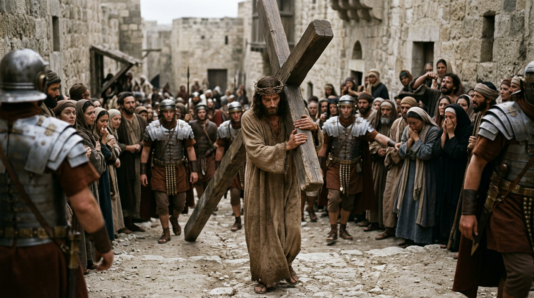
Led To Cavary Luke 23:26
As we dive into the moments leading up to Jesus’s crucifixion, let’s take a closer look at the journey to Calvary. Picture this: Jesus, heavy with the weight of the cross, surrounded by a crowd that’s a mix of curiosity, hostility, and sorrow. He walks that painful path, not just for Himself, but for all of humanity. Each step is a testament to His unwavering love and sacrifice. It's a moment that reminds us of the depth of His compassion and the incredible lengths He went to for our redemption. Join us as we explore this powerful chapter in the story of hope and salvation!
9am
Crucified Luke 23:33
Crucified — Luke 23:33
Luke 23:33 brings us to the stark centre of the story: “When they came to the place called the Skull, they crucified him there.” With one sentence, Luke anchors the event in a real location, under real Roman authority, using a method of execution reserved for rebels and slaves. Golgotha—“the Skull”—stood just outside Jerusalem’s walls, a public place chosen to make an example of the condemned. Here, Jesus is nailed to the cross between two criminals, fulfilling both Roman procedure and the prophetic imagery of the suffering servant numbered with the transgressors. It is a moment that is brutally historical and deeply theological, marking the beginning of the final hours that would reshape the world.
Luke 23:33 brings us to the stark centre of the story: “When they came to the place called the Skull, they crucified him there.” With one sentence, Luke anchors the event in a real location, under real Roman authority, using a method of execution reserved for rebels and slaves. Golgotha—“the Skull”—stood just outside Jerusalem’s walls, a public place chosen to make an example of the condemned. Here, Jesus is nailed to the cross between two criminals, fulfilling both Roman procedure and the prophetic imagery of the suffering servant numbered with the transgressors. It is a moment that is brutally historical and deeply theological, marking the beginning of the final hours that would reshape the world.
10am
Solders Divided His Clothes
Mark records that the soldiers “crucified him” and divided his garments, casting lots as part of the routine spoils of execution. Luke adds that the crowd’s demand for crucifixion had already been granted by Pilate, sealing Jesus’s fate under imperial authority. Together, these verses show the moment when legal judgment, Roman power, and public spectacle converged. What unfolds is not myth or metaphor but a documented first‑century execution carried out at a specific hour, in a specific place, under a specific governor
11am
Passersby Join the Mockery
Matthew 27:39–40 shows the crowd turning Jesus’s suffering into a spectacle. Passers‑by shake their heads and taunt him, twisting his words about the temple into a challenge: “Save yourself.” It’s exactly what Roman crucifixion was designed for—public humiliation, maximum shame, and a warning to anyone watching. Their mockery reveals how completely they misunderstood his mission, even as their words echo the very prophecy he was fulfilling.
11am
The Leaders Mock the Crucified King
Mark 15:31 shows the chief priests and scribes joining the chorus of mockery at the cross. These were the very people who should have recognised God’s work, yet they sneer, claiming Jesus saved others but cannot save himself. Their taunt drips with irony: they interpret his refusal to come down from the cross as proof he is not the Messiah, when in Mark’s narrative it is precisely by staying on the cross that he fulfils his mission. In this moment, religious authority aligns with Roman power, and both completely misread what is happening before their eyes.
11am
Soldiers Mock the “King”
Luke 23:36–37 shows the Roman soldiers joining the mockery, offering Jesus sour wine and taunting him to prove his kingship by saving himself. Their words reflect the standard cruelty of Roman execution squads, who often mocked condemned prisoners as part of the humiliation ritual. By challenging him as “King of the Jews,” they echo the charge nailed above his head and reinforce Rome’s message: anyone who claims royal authority against Caesar ends here. Yet their jeer carries a deeper irony—the one they mock as powerless is fulfilling his mission precisely by staying on the cross.
11am
A Criminal Joins the Mockery
Luke 23:39 shows one of the criminals crucified beside Jesus hurling insults at him. Even in his own agony, he joins the chorus of mockery, demanding that Jesus save himself—and them—if he truly is the Messiah. It’s a raw snapshot of desperation twisted into scorn. Luke uses this moment to highlight the contrast between two responses to Jesus at the cross: one man hardens, even in suffering, while the other (in the next verse) will turn toward hope.
12am
A Criminal Turns Toward Hope
In Luke 23:40–42, the second criminal breaks through the noise of mockery with a rare moment of clarity. He rebukes the other man, admitting their guilt while recognising Jesus’s innocence—a striking contrast in a setting where victims usually cursed Rome and their fate. Then he turns to Jesus with a simple, desperate request: “Remember me when you come into your kingdom.” In the final minutes of his life, this condemned man sees what the crowds, leaders, and soldiers miss: that the one dying beside him is a king whose kingdom is not ending, but beginning.
12am
Mercy on a Cross
Luke 23:40–43 captures one of the most striking moments at Golgotha. While one criminal mocks Jesus, the other rebukes him, admitting their guilt and recognising Jesus’s innocence—a rare confession in the chaos of a Roman execution. Then he turns to Jesus with a simple plea: “Remember me when you come into your kingdom.” In response, Jesus offers a promise no dying man could invent: “Today you will be with me in paradise.” In these final minutes, the cross becomes a place of judgment, mercy, and unexpected faith, revealing a kingdom that begins not in power, but in sacrifice
12am
A New Family at the Cross
John 19:26–27 captures a moment of quiet compassion amid the brutality of crucifixion. Seeing his mother and the beloved disciple standing near the cross, Jesus entrusts them to one another’s care: Mary to John, and John to Mary. In the chaos of a Roman execution, this deliberate act shows Jesus fully aware, still giving, still forming community even as he dies. It reflects first‑century Jewish responsibility for family, but it also signals something deeper—the creation of a new spiritual family shaped not by bloodline, but by loyalty to him.
Midday
Darkness at Noon
Mark 15:33 marks a dramatic turning point in the crucifixion narrative: at the sixth hour—around noon—darkness falls over the whole land. In a region known for bright midday sun, this sudden gloom would have been shocking, signalling that something far more significant than a routine Roman execution was unfolding. Whether understood as a natural phenomenon or a symbolic act of divine judgment, the darkness underscores the weight of the moment as Jesus enters the final stretch of his suffering
1pm to 2pm
The Cry of Abandoment
Matthew 27:46 records Jesus’s most haunting cry: “My God, my God, why have you forsaken me?” Spoken in Aramaic, it echoes the opening line of Psalm 22—a lament every Jew would recognise. Far from a collapse of faith, the cry reflects the depth of his suffering under Roman execution and the weight of bearing injustice. In quoting the psalm, Jesus voices the agony of the moment while pointing toward a text that ends not in despair, but in vindication. It is the emotional low point of the crucifixion, where the physical, spiritual, and prophetic threads converge.
1pm to 2pm
I Am Thirsty
John 19:28 marks a moment of stark humanity in the final minutes of the crucifixion. Knowing that his mission is nearly complete, Jesus says, “I am thirsty,” fulfilling Scripture and revealing the physical cost of Roman execution. Hours of blood loss, exposure, and exhaustion would have produced intense dehydration, making this cry both medically expected and theologically deliberate. In a scene filled with cosmic weight, this simple statement anchors the moment in real human suffering and signals that the end is now in sight.
2pm to 3pm
It Is Finished
John 19:30 captures the climactic moment of the crucifixion. After receiving the sour wine, Jesus cries out, “It is finished,” and bows his head in death. Far from a whisper of defeat, the phrase signals completion—his mission accomplished, the suffering endured, the Scriptures fulfilled. Roman executions usually ended in silence as victims slipped into exhaustion, but Jesus dies with a deliberate, final declaration. In that loud cry, the Gospel presents not a life taken from him, but a life willingly given.
3pm
The Final Surrender
Luke 23:46 records Jesus’s final act on the cross: he cries out, “Father, into your hands I commit my spirit,” and then breathes his last. Unlike most crucifixion victims who died in exhausted silence, Jesus dies with a loud, deliberate declaration—an act of trust rather than defeat. In a Roman execution designed to strip a person of dignity and control, Luke shows Jesus yielding his life willingly, not having it taken from him. It is the moment the suffering ends and the story’s turning point begins
3pm
The Earth Shakes and the Veil Tears
Matthew 27:51 describes the instant Jesus dies: the temple curtain is torn from top to bottom, the earth shakes, and the ground splits. For Matthew’s audience, the tearing of the veil—normally separating the people from the Holy of Holies—signals that something monumental has changed. What follows isn’t random chaos but a symbolic rupture: the old barriers are breaking, the world is reacting, and God is declaring that the death of Jesus has cosmic consequences.
3pm
Tombs Open and Saints Raised
Matthew 27:52 describes one of the most startling signs surrounding Jesus’s death: tombs break open and many holy people who had died are raised to life. Matthew isn’t describing random chaos but a symbolic eruption—death itself losing its grip. These resurrected saints won’t appear publicly until after Jesus’s own resurrection, but their rising signals that something cosmic has shifted. The moment Jesus dies, the world begins to change.
3pm to 4pm
The Centurion’s Confession
Matthew 27:54 captures the moment the execution squad realises this death is unlike any other. After the earthquake and the terrifying signs that follow Jesus’s final cry, the centurion and his soldiers are shaken to the core. These hardened Roman professionals—men who had seen countless crucifixions—suddenly confess, “Surely he was the Son of God.” In a narrative filled with mockery and misunderstanding, the first declaration of Jesus’s true identity at the cross comes not from disciples or priests, but from Rome’s own soldiers.
3pm to 4pm
The Crowd Goes Home in Shock
Luke 23:48 shows the reaction of the watching crowds as Jesus dies. These weren’t committed followers or hostile leaders—just ordinary people who had come to witness another Roman execution. But after seeing the darkness, the final cry, and the way Jesus died, they leave beating their chests—a gesture of grief, guilt, or deep unease. Luke paints a powerful picture: even those who came for spectacle walk away shaken, sensing that something profoundly wrong has just taken place.
3pm to 4pm
The Romans Move to Finish the Job
John 19:31–32 shows the brutal efficiency of Roman execution protocol. Because the next day was a major Jewish festival, the authorities asked Pilate to hasten the deaths so the bodies wouldn’t remain on the crosses. The soldiers respond in the standard way: they break the legs of the two men crucified beside Jesus. This shatters any ability to push up for breath, causing rapid suffocation. It’s a stark reminder that crucifixion wasn’t just torture—it was a system designed to control time, optics, and public order, even in death.
3pm to 4pm
Blood and Water
John 19:34 records a detail unique to this Gospel: instead of breaking Jesus’s legs, a soldier thrusts a spear into his side, and “blood and water” flow out. Roman soldiers were trained to ensure death, and this stab—likely upward into the chest cavity—served as a final confirmation. The mention of blood and water has sparked centuries of discussion, from medical explanations to symbolic readings, but John’s point is simple and emphatic: Jesus was truly dead. This detail anchors the narrative in eyewitness testimony and sets the stage for the resurrection that follows.