
Lucius Junius Gallio: The Roman Governor Who Anchors Paul’s Timeline
Timeline Videos — punchy, cinematic, historically grounded.
The Roman Official Who Walks Out of Stone and Into Scripture
Lucius Junius Gallio is one of the most securely proven figures in the entire New Testament world. Not just mentioned. Not just implied. Proven — by stone, by history, by archaeology, by Roman literature.
He’s the man who stood in Corinth while Paul preached, the man who dismissed the charges against him, and the man whose name is carved into one of the most important inscriptions ever found for biblical chronology.
Gallio isn’t a shadowy figure. He’s a Roman governor we can point to with absolute confidence.
A Family of Power and Philosophy
Gallio was born Lucius Annaeus Novatus, son of Seneca the Elder and older brother of Seneca the Younger — Nero’s tutor and one of Rome’s greatest philosophers.
He was adopted by the rhetorician Lucius Junius Gallio, taking the name that history remembers.
Seneca describes him as:
- Warm
- Gentle
- Loved by everyone
A rare compliment in Roman politics.
Proconsul of Achaia (AD 51–52)
Gallio served as proconsul of Achaia, governing southern Greece from Corinth. This is exactly where Acts 18 places Paul during his second missionary journey.
His tenure was short — likely cut short by illness — but historically explosive.
Gallio in Acts 18: A Courtroom Drama in Corinth
Paul is dragged before Gallio by synagogue leaders. They accuse him of persuading people to worship God “contrary to the law.”
Gallio listens. Gallio shrugs. Gallio dismisses the case.
To him, it’s an internal religious dispute, not a Roman legal matter.
This moment is crucial because Acts names him precisely:
“Gallio was proconsul of Achaia.”
And archaeology confirms it.
The Archaeological Smoking Gun: The Delphi Inscription
This is the single strongest piece of historical evidence for any Roman official mentioned in Acts.
What Was Found?
In 1905, archaeologists uncovered nine marble fragments at the Temple of Apollo in Delphi. They preserve part of a letter from Emperor Claudius.
What Does It Say?
It explicitly names:
“Lucius Junius Gallio, my friend and proconsul of Achaia.”
Why It’s So Important
Claudius’ titles in the inscription include his 26th acclamation as imperator, allowing scholars to date the letter precisely to AD 52.
This anchors Gallio’s governorship to AD 51–52 — exactly when Paul was in Corinth.
Historical Impact
- Confirms Gallio’s name
- Confirms his title
- Confirms his location
- Confirms his dates
- Confirms Acts’ accuracy
- Provides a fixed point for dating Paul’s ministry
This inscription is the chronological backbone of Pauline studies.
The Bema at Corinth: The Courtroom Itself
Archaeologists have excavated the bema — the judgment seat — in Corinth’s agora. This is the exact platform where Gallio would have heard Paul’s case.
It’s not hypothetical. It’s not symbolic. It’s a real stone structure you can stand on today.
Gallio’s Later Life
After Achaia, Gallio returned to Rome and served as suffect consul. Tacitus records that he was attacked politically but defended unanimously by the Senate.
He died around AD 65, possibly by suicide after his brother Annaeus Mela was implicated in a conspiracy under Nero.
Why Gallio Matters for Timeline Videos
Gallio is cinematic gold:
- A Roman governor with archaeological proof
- A brother of Seneca, linking Paul’s world to Nero’s court
- A figure who appears in Acts AND Roman history
- A man whose name is carved into stone, anchoring the New Testament to a precise year
- A courtroom scene set in a real, excavated location
Gallio is one of the few New Testament-era officials whose existence is beyond dispute — perfect for historically grounded storytelling.
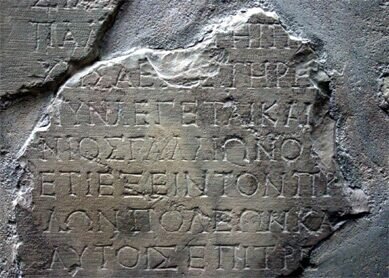
Gallio Inscription from Delphi