
Marcus Antonius Felix: The Freedman Who Ruled Judea Like a King
Timeline Videos — Punchy, cinematic, web‑ready.
The Roman Nobody Who Became One of the Most Dangerous Men in Judea
Marcus Antonius Felix shouldn’t have mattered. He wasn’t born noble, wasn’t trained for high office, and wasn’t destined for power. He was a freedman—a former slave—who rose only because his brother Pallas became one of Emperor Claudius’ most influential insiders.
But when Felix arrived in Judea around 52 CE, he stepped into one of the most volatile provinces in the empire… and ruled it with a brutality that still echoes through history.
A Province on the Edge
Felix inherited a land simmering with revolt. Messianic prophets, Sicarii assassins, corrupt elites, and Roman heavy-handedness were already pushing Judea toward explosion.
Felix didn’t calm it. He tightened his grip.
- He crushed uprisings with ruthless force.
- He hunted down the Sicarii, only to see them multiply.
- He confronted a charismatic prophet known simply as “the Egyptian”, who led thousands to the Mount of Olives expecting miraculous deliverance. Felix scattered them with Roman steel.
Tacitus later wrote that Felix ruled with “the power of a king and the mind of a slave.” A devastating line—and one that fits the archaeological and historical record.
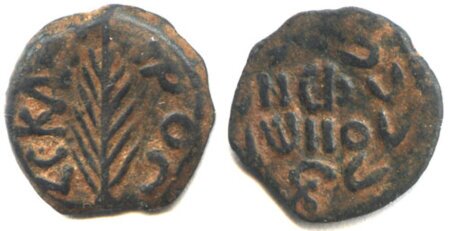
Bronze prutah minted by Antonius Felix.
Obverse: Greek letters ΝΕΡ ΩΝΟ Ϲ ("of Nero") in wreath.
Reverse: Greek letters ΚΑΙϹΑΡΟϹ ("Caesar") and date LC (year 3 = 56/57), palm branch.
Felix Meets Paul
Felix’s name enters Christian history through Acts 23–24, where he becomes a key figure in the Apostle Paul’s story.
Paul is dragged before him in Caesarea, accused by Jerusalem’s leaders. Felix listens. Felix delays. Felix waits for a bribe.
For two years, Paul remains imprisoned under Felix’s watch—an extraordinary detail that matches the political chaos Josephus describes in the same period.
Felix’s wife, Drusilla, daughter of Herod Agrippa I, sits beside him during these hearings. Her presence is historical gold: a Herodian princess married to a Roman freedman, linking two dynasties that shaped the world of the New Testament.
The Fall of Felix
By 60 CE, Judea was boiling. Violence was rising. Complaints against Felix reached Rome.
He was recalled—disgraced but not punished, protected once again by his powerful brother Pallas. Felix disappears from the record soon after, leaving behind a province spiralling toward the Great Jewish Revolt.
How We Know Felix Was Real
Felix is one of the best-attested Roman officials of the era. His existence is confirmed by:
1. Multiple Ancient Historians
- Josephus — extensive detail on his administration.
- Tacitus — confirms his character and rule.
- Acts of the Apostles — independent narrative matching Roman procedure.
2. Archaeology
Coins minted under Felix—actual physical artefacts—carry his name and symbols of Roman authority. These are hard, material proof of his governorship.
3. Administrative Records
Felix fits perfectly into the known sequence of Roman procurators: Cumanus → Felix → Festus All three are independently attested.
Why Felix Matters Today
Felix’s story is a window into the world of the New Testament—where politics, prophecy, violence, and empire collided. He stands at the crossroads of Roman power, Jewish resistance, and early Christian history.
For Timeline Videos, Felix is a character who embodies the tension of the era: a freedman elevated beyond his competence, ruling a land he never understood, and leaving behind a legacy of unrest that shaped the world Paul walked through.