
Has Noah's Ark Been Found - Answer No, Not On Mount Ararat!
Several 2025–2026 research teams have been scanning and drilling at the Durupınar formation, a boat‑shaped mound near Ararat — not on the mountain itself.
What they did find:
- Soil anomalies and organic traces (possibly decayed wood)
- Subsurface voids and right‑angle features from radar scans
- Pottery fragments and elevated carbon levels in soil samples
- Marine deposits and shellfish remnants dated 3500–5000 years old
What they did not find:
- No exposed structure
- No confirmed ancient wood
- No tools, fittings, or human occupation layers
- No verified archaeological context linking the site to Noah
Academic archaeologists continue to state that Durupınar is a natural formation, despite the new anomalies.
Full explanation below.
Full explanation below.
Why Noah’s Ark Is Not on Mount Ararat
The Geological, Historical, and Archaeological Case
The Geological, Historical, and Archaeological Case
For centuries, explorers have climbed Mount Ararat hoping to find the remains of Noah’s Ark. The idea is iconic, dramatic, and deeply embedded in popular imagination. But the evidence — geological, historical, and archaeological — points in a very different direction. Mount Ararat is almost certainly not the landing place of the Ark described in Genesis.
This article lays out the case clearly and concisely: Ararat is the wrong mountain, the wrong timeline, and the wrong geology — and every claimed discovery to date has failed under scrutiny.
1. Wrong Place: The Bible Doesn’t Point to Mount Ararat but to a region
The Durupinar site of recent media interest is roughly 18 mile south of the modern mountain we call Mount Ararat (Ağrı Dağı in Turkish) today; in extreme eastern Turkey. The bible doesn’t describe one mountain but a vast region that covers Eastern and SE Turkey, Armenia and NW Iran
Genesis 8:4 states that the Ark rested on the “mountains of Ararat” — this is a region, not a single peak. In antiquity, “Ararat” referred to the Urartu highlands, a broad mountainous zone stretching across modern east and SE Turkey, all of Armenia, northern Iraq and NW Iran.
There is another candidate in this region called Mount Dudi (also called Mount Cudi / Judi) with much stronger evidence for being the location of Noah’s ark. See report “Mount Cudi: The Forgotten Mountain of Noah’s Ark”
2. Only Recently Called Mount Ararat
The modern volcanic peak known today as Mount Ararat (Ağrı Dağı) is a late arrival to the biblical conversation. Despite its fame in popular culture, the mountain did not carry the name “Ararat” in ancient times — not in the Old Testament period, not in the classical world, and not in the early Christian era.Historical records show that the association between the mountain and the name “Ararat” only appears around the 11th century AD. That’s more than 2,000 years after the events described in Genesis. Before this medieval rebranding, the mountain was known locally by other names, including Ağrı Dağı and Masis.
3. Wrong Shape: The Bible describes a box-like structure.
The Bible clearly states the shape of Noah’s Ark; by using the Hebrew word tebah the bible indicates a rectangular, box-like structure rather than a traditional boat shape.
This box-like shape has been shown the best for floatation, preservation and stability in turbulent water.
This box-like shape has been shown the best for floatation, preservation and stability in turbulent water.
The Durupınar shape does not fit the description in the Bible. The Ark Experience in Kentucky is probably a better representation of what it looked like.
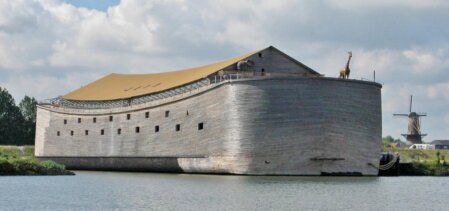
4. Wrong Timeline: Mount Ararat Didn’t Exist At Noah’s Time
Mount Ararat’s geological profile is decisive:
- It is a post-Flood volcano, formed by eruptions that occurred after the waters receded.
- Its structure consists of stacked lava flows, not ancient pre-Flood rock.
- The volcanic cone is too young to match any plausible Flood chronology.
Geology confirms that Mount Ararat is a young stratovolcano, built up through repeated eruptions long after the Flood period. Its lava flows sit on top of thousands of feet of sedimentary layers associated with the Flood. These sedimentary layers contain marine fossils.
Even conservative geologists who accept a global Flood agree: the snow capped volcanic Mount Ararat is too young. The Ark could not have landed on a mountain that did not exist at the time!
5. The Ark Has Never Proven to Have Been Found on Mount Ararat
Despite numerous expeditions, no confirmed remains of Noah’s Ark have ever been discovered on Mount Ararat.
6. No Artifacts Have Ever Been Found on Mount Ararat
Archaeology depends on context — layers, artifacts, human activity. Mount Ararat has produced none of the following:
Across all claims: - No ancient wood
- No metal fittings
- No pottery
- No tools
- No human occupation layers
Nothing that would indicate a large wooden structure ever existed on Mount Ararat.
A site that hosted the Ark — a massive wooden vessel used by eight people for months — would leave something behind. Ararat leaves nothing. Whilst some ancient pottery was found (confirmed by Dr. Faruk Kaya) this doesn’t prove the ark itself was there.
7. There Are other Geological Syncline Formations Around the World and Locally similar to Durupınar
Other locations around the world have similar Duripinar formations such as this one near Mount Ararat. Examples;
- The Sideling Hill Syncline (Maryland, USA): A highly visible, textbook example of a syncline. When viewed from above or via cross-section, the folded rock layers resemble the curved bottom and symmetry of a massive ship hull.
- The Calico Hills Synclines (California, USA): Located in the Mojave Desert, these plunging folds create distinct, elongated, vessel-shaped troughs across he arid landscape due to differential erosion of varying rock types.
- The Basque Arc Folds (Spain): Tectonic compression against the Pyrenees has left behind several "doubly plunging" folds that perfectly mirror the pointed bow and rounded stern of maritime vessels when exposed at the surface.
- Local Mudflow
- Formations (Volcanic Terrains): Because Durupinar is specifically a mudflow feature formed around a volcanic core, identical hull-shaped ridges occur around active volcanic regions in South America and the South Pacific, where viscous debris splits around solid rock and harden.
This illustration shows how a boat like structure is formed. The sedimentary rocks are laid down in layers then folded. The top layers are then eroded away leaving behind the exposed cross sections. The soft rocks erode quicker leaving the behind the harder rock. The site photographs you see today show that the site has be subject not only to natural erosion but to man made erosion since to was photographed in 1959.
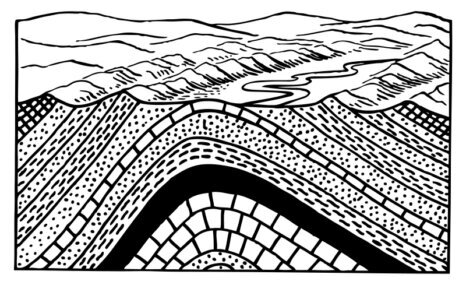
Syncline in Cross Section
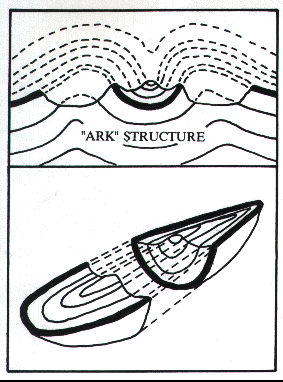
Photograph taken in 1959
Photograph taken in 2007
8. A Review of Claimed Ark Discoveries — and Why They Fail
Over the last century, several high‑profile claims have circulated. None withstand scientific or historical scrutiny.
Ararat Anomaly (1949)
Cold War aerial photos showed a shape in the ice. Later high‑resolution imaging revealed it to be a rock outcrop, not a structure.
Cold War aerial photos showed a shape in the ice. Later high‑resolution imaging revealed it to be a rock outcrop, not a structure.
a) George Hagopian’s Story
A childhood memory of seeing the Ark on Ararat — but no coordinates, no physical evidence, and no corroboration.
A childhood memory of seeing the Ark on Ararat — but no coordinates, no physical evidence, and no corroboration.
NAMI’s “Interior Compartments” (2010)
A dramatic claim from a Hong Kong group. Subsequent investigation found:
A dramatic claim from a Hong Kong group. Subsequent investigation found:
- Evidence of staged scenes
- Wood dated to the Middle Ages, not antiquity
- Fabricated structures placed inside caves
b). Durupınar Formation
Often promoted as a boat-shaped outline. Geologists — including a 1996 study from California State University Northridge titled “Bogus ‘Noah’s Ark’ from Turkey Exposed as a Common Geologic Structure” — concluded it is:
Often promoted as a boat-shaped outline. Geologists — including a 1996 study from California State University Northridge titled “Bogus ‘Noah’s Ark’ from Turkey Exposed as a Common Geologic Structure” — concluded it is:
- A natural geologic formation
- Formed by erosion, not human construction
c). Fernand Navarra’s Wooden Beam
Navarra claimed to retrieve ancient wood from Ararat.
Radiocarbon tests showed:
Navarra claimed to retrieve ancient wood from Ararat.
Radiocarbon tests showed:
- The wood was not ancient
- Multiple accusations emerged that the wood had been planted
d). Mount Suleiman “Beam-Shaped Rocks”
Geological formations mistaken for petrified wood. No artifacts, no structure, no archaeological context.
Geological formations mistaken for petrified wood. No artifacts, no structure, no archaeological context.
e). Cubits Manipulated to Fit the Ark
Some promoters stretched the Durupınar formation to match the Ark’s biblical dimensions by using the Egyptian Royal Cubit (0.5236 m) instead of the Hebrew Cubit (0.45 m). This is an artificial adjustment to force a match. One further point is how is Noah using Egyptian Royal Cubits when the Egyptians did not exist yet!
Some promoters stretched the Durupınar formation to match the Ark’s biblical dimensions by using the Egyptian Royal Cubit (0.5236 m) instead of the Hebrew Cubit (0.45 m). This is an artificial adjustment to force a match. One further point is how is Noah using Egyptian Royal Cubits when the Egyptians did not exist yet!
f). Ron Wyatt’s Claims
Wyatt claimed “trainloads of gopher wood” and metal fittings - never found! No evidence has ever been produced. No artifacts have ever been verified. His claims that he found petrified wood, laboratory and field assessments identified the material described as "petrified wood" as ordinary rock and weathered volcanic material rather than fossilized cellular wood. Wyatt declined to submit his "wood samples" for proper microscopic thin-section analysis to verify wood structures.
Wyatt claimed “trainloads of gopher wood” and metal fittings - never found! No evidence has ever been produced. No artifacts have ever been verified. His claims that he found petrified wood, laboratory and field assessments identified the material described as "petrified wood" as ordinary rock and weathered volcanic material rather than fossilized cellular wood. Wyatt declined to submit his "wood samples" for proper microscopic thin-section analysis to verify wood structures.
g). 2026 expedition to Mount Ararat
Have produced no artifacts, pottery, no occupation layers. Claims based on the ground radar have not been confirmed by external reviewers – some images are clearly AI generated. No real evidence has been produced.
Have produced no artifacts, pottery, no occupation layers. Claims based on the ground radar have not been confirmed by external reviewers – some images are clearly AI generated. No real evidence has been produced.
Media claims of 100% confirmed that man made structures have found are totally false. Reported statement from Andrew Jones the founder of Noah’s Ark Scans said neither limestone nor solid bedrock were detected.
“This destroys the theory the site is a solid limestone block shaped into a boat by glaciers and weathering after coming down the mountainside, and it also refutes the theory that this is bedrock around which mud flowed to form the shape,” he said. This contradicts peer reviewed geological survey and reports done by both Christian and secular scientists. Ground radar would not show this!
The paper refereed to here (see (1)) is a paper by David Franklin Fasold refers to “Fossiliferous limestone intersects the Ark structure on one side and is also found in outcrops on both sides beyond the adjacent landslide debris. On that basis, the doubly plunging syncline has likely formed in situ rather than being an allochthonous block transported in a landslide.”
Another claim by Andrew Jones is that the soil samples taken show high levels of potassium. However, Mount Ararat is a dormant compound stratovolcano which are known to produce calc-alkaline rocks ranging from basalt to rhyolite, which naturally contain potassium-bearing minerals like potassium feldspar (orthoclase) and biotite mica. In fact, the surrounding areas around many volcanos are well known to be rich in potassium which make the fields very fertile for crops. The last time there was an eruption was July 2 1840. Type was phreatic – steam-driven explosion – with pyroclastic flow and mud flows. It produced a 7.4 earthquake and a massive landslide which destroyed a village.
Andrew Jones claims the Mount Ararat is in the Mountains of Ararat true but the Bible clearly states that the Ark rested on the mountains of Ararat and does say that it landed on Mount Ararat. Genesis 8:4
15. The Drogue Stones – Noah’s anchors.
If you look at the photograph of these you can clearly see the hole in the top. Problem nowhere in the Bible does it mention that Noah used them guide or anchor the Ark. Also look at the hole if you put a rope in there would be marks of the rope. But the biggest problem is that the top of the stone would simply snap under the weight of the stone if used as an anchor. Some articles only mention 8 stones the number of Noahs family when in fact there are 26. A geological investigation of samples taken from the stones, published by geologist Lorence Collins in co-authorship with their original discoverer David Fasold found that they are made from local stone andesite and therefore could not have been on the Ark at the beginning of the flood.
Noah could not have cut drogue stones loose — the Ark’s design makes it impossible
Genesis gives us one door (Gen 6:16), one window (Gen 6:16), and no upper deck. The door is shut by God (Gen 7:16). The window is tiny and placed near the roof.
This means:
- No access to the outside hull
- No access to the underside
- No access to the bow or stern
- No ability to reach or cut ropes
- No deck from which to work
- No mechanism to deploy or retrieve stones
The Ark is described as a sealed box, not a sailing vessel.
So the idea that Noah’s family leaned over the side to cut loose 10‑ton stones is simply impossible.
9. Why Much of the Ark Is Unlikely to Survive Today
Even if the Ark landed somewhere in the Ararat region (the broader Urartu highlands), it is extremely unlikely that any part of it survives.
Repurposing: Noah’s family likely dismantled the Ark for:
- Shelter for a while they established somewhere to live
- Fuel
- Tools
- Construction materials
This was common ancient practice.
Decay: Wood exposed to:
- Moisture
- Freeze–thaw cycles
- Microbial activity
…will collapse within centuries.
Glacial Movement: Glaciers grind, crush, and transport material. Any wooden structure on a high mountain would be pulverized.
Conclusion: The Evidence Points Away from Mount Ararat
Mount Ararat is a beautiful, dramatic mountain — but it is not the resting place of Noah’s Ark. The geology is wrong. The timeline is wrong. The history is wrong. And every claimed discovery has collapsed under scrutiny.
The search for the Ark must move beyond the volcanic cone of Ararat and return to the broader Ararat region described in Genesis — especially areas with ancient traditions, archaeology, and geography that actually fit the biblical account.
(1) Creation Science 1 of 9
Mount Cudi: The Forgotten Mountain of Noah’s Ark
For centuries, Western imagination has placed Noah’s Ark atop the icy crown of Mount Ararat — a solitary volcanic cone rising above the Armenian plain. Painters, poets, explorers, and modern expeditions have reinforced this image until it became almost unquestioned. Yet the earliest, strongest, and most culturally diverse ancient witnesses point somewhere else entirely: a long limestone ridge above the Tigris River in southeastern Turkey, known today as Mount Cudi.
For close to two thousand years the people who lived nearest the mountains in question pointed to Mount Cudi and not north to Ararat.
This article explores why — and how — Mount Cudi became the original mountain of the Ark, why Ararat took over in later centuries, and why Cudi deserves renewed attention today.
1. Geography: A Mountain You Could Walk Past
Mount Cudi (Turkish: Cudi Dağı, pronounced “Judi”) lies in Şırnak province, close to the borders of Iraq. It rises to about 2,114 meters — high enough to hold snow into early summer, low enough to be accessible without technical climbing. The ridge carries several summits above 2,000 meters, and the peak associated with the Ark is not even the highest.
Unlike Ararat, which dominates the horizon from fifty miles away, Cudi is modest. Yet this unassuming ridge holds the oldest recorded claim to Noah’s landing place.
“Mount Cudi sits about four hundred kilometres south, a long grey limestone ridge above the Tigris… high enough to hold snow… low enough that you could travel the road beneath it and never look up.”
This accessibility is crucial. The earliest witnesses describe people climbing the mountain, visiting the remains, and bringing back relics. No ancient source describes anything remotely like that on Ararat’s 5,137-meter ice cap.
ndon, 1800), p. 30: https://archive.or
2. The Biblical Starting Point: Ararat, Lûbâr, and Early Ambiguity
The Genesis flood narrative ends with a simple statement:
“The Ark came to rest on the mountains of Ararat.” Genesis 8:4
This phrase is geographical, not specific. “Ararat” in the Hebrew Bible refers to a region — the ancient kingdom of Urartu — not a single peak. The Book of Jubilees later specifies a mountain named Lûbâr, but even this does not correspond to the volcanic cone of modern Ararat.
The Torah does not describe any particular holiness about the Ark, and so little attention is given to its fate after Noah’s departure.
People desired to work out its location and the earliest interpreters overwhelmingly pointed south, not north.

3. The Earliest Witnesses: Berossus, Josephus, and the Qardu Highland
The first clear statement comes from Berossus, a Babylonian priest writing in Greek in the third century BC. He records that remnants of the Ark still lay on a mountain in the Qardu highland — the region that includes Mount Cudi — and that people scraped hardened tar from the vessel to carry as charms.
Three centuries later, Josephus quotes Berossus almost word for word and adds that locals were still showing the remains “to this day.” Josephus attempts to harmonize various traditions, linking Noah’s story to Sumerian flood accounts, and even mentions Carrhae as a location where locals claimed to show Ark remains.
This shows that even in Josephus’ time, multiple traditions existed — but none describe the glaciated peak of Ararat. All point to accessible mountains in the Qardu/Corduene region.
4. The Aramaic Bibles: Translating Ararat as Qardu
When Jewish and Syriac translators rendered Genesis 8:4 into Aramaic, they did not preserve the sound of “Ararat.” They translated it.
- Targum Onkelos: “mountains of Qadron / Qardu”
- Targum Neofiti: “mountains of Qardu”
- Peshitta: “mountains of Qardu”
“The targumim for Genesis 8 interpret ‘Ararat’ as ‘Qadron’ and ‘Kardu’ (i.e., Corduene).”
These translators lived in the region. Their readers lived within sight of the hills. For them, “Ararat” meant the Qardu highland — the range that includes Mount Cudi.
This is one of the strongest arguments in the entire debate.
5. Jewish Tradition: Sennacherib and the Beam of the Ark
Sennacherib third military campaign directed against the kingdoms and city states in the Levant. In 705 BC Hezekiah the king of Judah had stopped paying annual tribute to the Assyrians. He attached and besieged Jerusalem in 701 BC
The Talmud relates an account of the Assyrian King Sennacherib around 699-697 during his fifth military campaign targeting the region of Ukku along the greater Zab river. He visited the site of the Ark retried a plank from it and fashioning into an idol call Nisroch.
Sennacherib went and found a beam from Noah’s ark, from which he fashioned a god. … He said: “If that man (referring to himself) goes and succeeds [in battle], he will sacrifice his two sons before you.” His sons heard his commitment and killed him. This is the meaning of that which is written: “And it came to pass as he was worshipping in the house of Nisroch his god that Adrammelech and Sarezer, his sons, smote him with the sword, and they fled to Ararat” (2 Kings 19:37), where Noah’s ark had come to rest (Sanhedrin 96a)
He carved rock reliefs directly onto the slopes of Mount Cudi, documenting his royal ascent and military actions. Around 697-699 BC
Six distinct Assyrian rock reliefs detailing the campaigns of King Sennacherib have been documented on the cliffs and slopes of Mount Cudi (Judi Dagh) in southeastern Turkey. These monuments serve as permanent markers of Assyrian imperial dominance over the rugged northern frontier
Sennacherib really was on Mount Cudi. He carved reliefs into the mountain. The legend plausibly grew around a real king known to have been physically present at the Ark’s traditional mountain.
A Midrash claims Haman’s gallows were built from a beam of the Ark.
These are late traditions — theological stories rather than historical claims — but they show how deeply the Ark’s memory was embedded in the Mount Cudi region.
6. Syriac Christianity: Monasteries, Pilgrimage, and Relics
The Monastery’s Destruction: A Tragedy on the Mountain
The monastery did not survive into the medieval period, and a chronicle finished nine years after the event records how it ended.
In November 766, a large crowd climbed the mountain for a customary feast at the place where the Ark came to rest. Lightning struck the shrine. Fire consumed it with the people inside, turning its stones to lime. The chronicler puts the dead at seven or eight hundred and says nobody got out.
It was never rebuilt on the same footing.
Ruins That Still Speak
Foundations and worked stone remain on the heights — the last physical witnesses to a tradition that stretched across cultures and centuries. These ruins are the reason anyone can still speak about the place in the present tense at all.
Whatever else is uncertain about Mount Cudi, there are ruins on it, and they are ruins of buildings that existed specifically because of Noah.
This is not the story of a legend drifting north to Ararat. This is the story of a mountain where the Ark tradition became a physical, enduring reality.
7 A Mountain Worth Climbing: Heraclius’ Visit
The most striking visitor came three centuries later.
In AD 627, after breaking the Persian armies at Nineveh, the Byzantine emperor Heraclius began his triumphant return home. But instead of marching straight west, he turned aside. Arabic sources record that he entered the district known as Themanin — “The Eighty,” a name tied to Noah’s companions — and climbed Mount Cudi to see the place where the Ark had landed.
A reigning emperor, fresh from one of the most decisive victories in Late Antiquity, made a deliberate detour to ascend Cudi. Not Ararat. Not a symbolic peak. A real mountain with a living tradition.(1)
8. Early Christian Apologetics: Ark Remains as Proof
Epiphanius of Salamis The fourth-century C.E. Greek qristian writer Epiphanius gives particularly explicit testimony. In the Panarion he says that the Ark rested: in the highlands of Ararat;between Armenia and Cardyaei;on the mountain called Lubar.
John Chrysostom: “Are not the remains of the Ark preserved there to this very day?”
Ephrem the Syrian: A Voice from the Region of Qardu (Mountains of Ararat)
Ephrem the Syrian lived in the fourth century, teaching and writing in Nisibis and later Edessa — cities positioned directly beside the Qardu highlands. He belonged to the cultural world that looked south toward the Tigris, not north toward the volcanic cone of Ararat.
Modern studies of Syriac sources consistently show that Mount Qardo (Cudi) and the “mountains of Qardo (Ararat)” remained the standard Ark localization in much of Syriac Christian literature. The particular peak associated with the monastery was known simply as the Mountain of the Ark.
This was not a borrowed Islamic idea. It was the living memory of the Christian communities who inhabited the region long before the rise of Islam.
These statements reflect a world in which Ark remains were believed to be visible and accessible — something impossible on Ararat’s ice cap.
As Christianity spread across Europe, the apologetic value of Ark relics diminished, and the tradition began to shift.
9. Islamic Tradition: The Quran and Early Muslim Geographers
By the seventh century, the Ark tradition on Mount Cudi was no fringe belief. It was old, local, and deeply rooted in the communities who lived around the Tigris. And then it received the most widely read endorsement it would ever gain: the Quran named the mountain.
Where the Hebrew Bible refers to the “mountains of Ararat” — a region — the Quran is explicit. Surah Hud states that the Ark came to rest upon al‑Judi. This is the same name, in Arabic form, that Syriac and Aramaic writers had been using for centuries. The identification was clear to everyone who lived in the region.
Early Muslim Geographers: No Doubt About the Mountain
The geographers of the early Islamic world catalogued the lands of the caliphate with precision, and none hesitated over the meaning of al‑Judi.
Al‑Masudi (10th century)
The Baghdadi scholar and traveler describes the mountain as running as far as Jazirat ibn Umar — modern Cizre — on the Tigris. He writes that the place where the ship came to rest could still be seen on the summit. He also places it eight farsangs from the river, roughly thirty‑two miles by his translator’s reckoning. The farsang was an elastic unit, and the figure sits awkwardly beside his description of the mountain reaching the riverbank, but the identification itself is unmistakable. (2)
Ibn Hawqal (10th century)
A contemporary of al‑Masudi, Ibn Hawqal fixes al‑Judi near Nisibin — modern Nusaybin — about eighty kilometers west of the mountain. Again, the geography points to the same region: the Qardu/Corduene highlands where Mount Cudi stands. (3)
Qazvini (13th century)
Writing centuries later, Qazvini records that wood from the Ark was still being seen on Mount Judi during the Abbasid period. Whether these reports reflect relics, tradition, or misinterpretation, they show that the memory of the Ark on Cudi remained alive well into the medieval era.
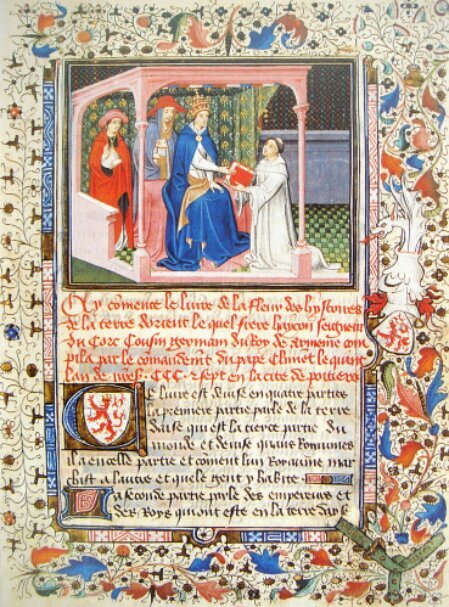
10. The Medieval Shift: How Ararat Took Over
“Christians in Armenia did not adopt the idea of Masis (Mount Ararat) as the landing site of the Ark until the arrival of Crusaders in the late 11th century.”
After the Crusades:
- Armenians adopted the Western identification of Masis (Greater Ararat).
- The Jacob of Nisibis legend was relocated to Ararat.
- A pre-Christian taboo against climbing Masis (Mount Ararat) was reinterpreted as reverence for the Ark.
- Travelers described the summit as inaccessible due to snow and precipices.
- Reports of Ark fragments on Ararat multiplied, though inconsistently.
Late medieval accounts vary:
- Petachiah of Regensburg: “the Ark is not there, for it has decayed.” 1217 AD
- Hayton of Corycus: “something black is visible… which people say is the Ark.” 1307 AD
Sir Walter Raleigh attempted to redefine “Ararat” as a broad mountain system to reconcile traditions in his 1614 work the History of the World
But by then, the shift was complete. Mount Ararat had become the mountain of Western imagination.
11. Why Mount Cudi Matters Today
Mount Cudi is not a fringe theory. It is the oldest theory. It is the most geographically plausible. It is the most culturally attested. It is the only mountain with ancient ruins built because of Noah.
Whatever else is uncertain about Mount Cudi, there are ruins on it, and they are ruins of buildings that existed specifically because of Noah.
For anyone exploring the historical roots of Genesis — scholars, filmmakers, or curious travellers — Mount Cudi deserves to stand beside Göbekli Tepe, Harran, and Ararat itself as one of the most important landscapes of biblical antiquity.
Conclusion: Rediscovering the Original Mountain of the Ark
The story of Mount Cudi is not about disproving Ararat. It is about recovering a forgotten memory — one shared by Babylonians, Jews, Syriac Christians, Byzantines, and Muslims across two millennia.
Ararat is the mountain of modern imagination. Cudi is the mountain of ancient testimony in the Mountains of Ararat.
As archaeological access to Şırnak improves and interest in early biblical landscapes grows, Mount Cudi may yet reclaim its place as one of the most compelling sites in the world’s oldest flood tradition.
Conclusion: Mount Cudi Is the Ancient World’s Ark Mountain
Mount Ararat may dominate modern imagination, but the ancient world — the people closest to the event, the languages closest to the text, and the traditions closest to the geography — consistently identified Mount Cudi in the mountains of Ararat as the landing place of Noah’s Ark.
For close to two thousand years the people who lived nearest the mountains in question pointed to Mount Cudi close to the Turkey/Iraq border and not north to Ararat on the Turkey/Armenia border.
Cudi is reachable. Cudi is ancient. Cudi is attested. And unlike Ararat, Cudi has never been properly excavated — meaning the most historically grounded candidate remains the least explored. This mountain is above the plains of Shinar (ancient biblical name for the region of Babylonia) where Noah’s family settled after the flood and became the cradle of civilisations. This make far more sense as God would have positioned the Ark on a safe location, with gentle slopes and easy access for Noah’s family and animals to repopulate the Earth
Reference
(1) Ibn al-‘Amid (al-Makin), Historia Saracenica, ed. T. Erpenius (Leiden, 1625), p. 17. Full scan: https://archive.org/details/ned-kbn-all-00001272-002. The episode also survives in the chronicle behind Theophilus of Edessa, trans. R. G. Hoyland (Liverpool University Press, 2011), p. 78.
(2) Al-Masudi, Meadows of Gold, trans. A. Sprenger (London, 1841), p. 73: https://archive.org/details/historicalencycl00masrich. Sprenger places al-Judi as extending to Jezirah Ibn ‘Omar, eight farsangs from the Tigris; the gloss of about thirty-two miles is his own.
(3) Ibn Hawqal, in W. Ouseley (trans.), The Oriental Geography of Ebn Haukal (L
Last Words
As followers of Christ, we are called to test every claim and hold fast only to what is true. The excitement surrounding the Durupınar formation has been driven more by enthusiasm and promotion than by verifiable evidence, and decades of geological and archaeological study continue to show that this site is a natural formation—not the remains of Noah’s Ark. When Christians elevate unproven discoveries or repeat claims that cannot withstand scrutiny, we risk undermining our credibility and distracting from the far stronger, well‑established historical and archaeological foundations of Scripture.
The good news is that the Christian faith does not depend on sensational claims. The world of the Bible is illuminated by a wealth of genuine, peer‑reviewed discoveries that affirm its people, places, and history. By grounding ourselves in what is true, we strengthen our witness, honour Christ, and present a faith that is both intellectually honest and spiritually compelling.